Payment even on delivery

You can choose cash on delivery. Enter your measurements on the product page: we'll check them with you during your call, then we'll produce.

Shipping traced

Reinforced packaging and tracking: always know where your order is, with no surprises.

Direct assistance
Production on demand
Reinforced packaging
Photographic comparison of iron table legs: on the left, a low-cost example with a rough orange peel finish, defective spot welds, and a list of highlighted defects. On the right, a high-quality Decimus example with a smooth finish and continuous welding - internal image.

Table of Contents

Introduction

When you start looking for iron table legs, you almost always find yourself at a crossroads that isn't actually a choice. On one side, the industrial marketplace product: low price, fast shipping, promises of "more than sufficient" sturdiness. On the other, the so-called "premium artisanal" product: high prices, glossy marketing, words like design, made in Italy, and handmade.

The problem is that, in between, you often find nothing. And whichever path you take, you almost always end up giving up something fundamental:

real stability

duration over time

consistency between what is declared and what actually holds true

The result is well known: legs that wobble, tops that warp, finishes that seem perfect at first but degrade over the years. Not because the iron is "wrong," but because the design was flawed from the start.

The real market: three origins, three different errors

Talking generically about "quality" isn't helpful. It's important to distinguish how various manufacturers of iron table legs actually work, because mistakes aren't all the same.

Production from international marketplaces: the product designed to sell, not to last

How the product is born

Here the focus is not on the structural quality of the iron table legs, but:

the final price

the expedition

the immediate aesthetic result

Many of these products come from retailers who purchase directly from China. Iron is chosen for its cost and availability, often referred to generically as "metal." The thicknesses are reduced to the minimum necessary to stand upright. The geometries are standardized, designed to be suitable for "a bit of everything."

Often, in some points where the iron joins, the joints are not even welded, leaving critical areas without structural continuity.

Because at first everything seems okay

When they arrive:

they are straight

they are heavy "just right"

the finish is uniform

But it's static, not structural, solidity. The product is designed to survive the first use, not ten years of loads, impacts, and torsions.

The real limit

No one has analyzed:

your plan

its weight

its length

how it will be used

As a result, the product is sized for an abstract average, not a concrete reality. Over time, vibrations, micro-movements, and a loss of rigidity appear.

European mass production: the elegant compromise

The material: DC01 and stamping sheets

Many European manufacturers use steels like DC01. It's a suitable material... for molding, not for load-bearing structures subject to stress. It's inexpensive and easy to work with, but:

bends first

works poorly on dynamic loads

does not tolerate large lights

It's no coincidence that these manufacturers claim load capacities of 60–70 kg. Not because they're dishonest, but because they know exactly where they're stopping.

The unstated problem

These legs:

they seem solid

they are “iron” to the touch

but they work like sheet metal

They're ideal for lightweight tables, desks, and decorative furniture. They become a problem when the top is long, heavy, or valuable.

Discover Decimus solutions

The fake Italian premium: good materials, questionable choices

Many Italian producers:

they use certified iron

they know how to weld

they know the trade

The problem is not what they use, but how they use it when no one is looking.

Painting: everyone's pride, manufacturers' weak point

What they don't do:

Powder coating is often the main selling point for iron table legs. Powder coating is applied:

without sandblasting

without shot peening

on smooth or freshly degreased iron

This is because sandblasting costs:

time

money

• innovative business organization based on the use of technologies and digitalization of internal and external processes, as well as the active and continued promotion of the services we offer through business development, marketing and communication systems (letter "I" of our logo actually stands for "Innovation");

Because it doesn't hold up over time

The powder doesn't chemically bond to the metal: it adheres almost exclusively through mechanical anchoring (the "grip"). If the surface is smooth, shiny, or poorly prepared, adhesion is merely an optical illusion. Many competitors avoid sandblasting to reduce costs, but this radically compromises the quality of the part.

When metal isn't sandblasted, the paint initially appears perfect. But it doesn't take long for a process of degradation to begin, leading to disastrous consequences, often ignored until it's too late:

  • The "Peel-Off" Effect (Leaf-Off): This is the worst-case scenario, the one that destroys your reputation. Since the paint isn't "rooted" in the metal, it can peel off in large pieces, like an old sticker or poorly-glued plastic film. We're not talking about a small scratch, but entire areas of paint that peel off, leaving the metal exposed. This irreparable aesthetic damage makes the product look cheap and "fake."

  • Impact fragility: Mechanical resistance collapses. Even common objects like vacuum cleaners, chairs, or cutlery can chip the paint, as the dust is merely "seated" and not anchored in the roughness of the metal.

  • Weld vulnerability: Weld seams are rich in silicates and thermal residues that repel paint. If not mechanically removed with sandpaper, they create microbubbles and detachments precisely at the points of greatest structural stress on the table, where the seal should be maximum.

  • "Edge escape": On sharp, non-sandblasted edges, the paint tends to shrink during baking due to surface tension, becoming very thin. There, the protection is almost nonexistent, and rust sets in immediately, eating away at the metal precisely at the most visible corners.

  • Cobweb corrosion: Without a rough base to block oxidation, if the table gets an accidental scratch, moisture will penetrate and crawl under the healthy paint like a cobweb, lifting the finish for inches around the damage.

All these problems arise directly from the lack of sandblasting. Without the microscopic roughness, the powder remains unstable.

Bottom line: Avoiding sandblasting saves the manufacturer money, but adds a devastating hidden cost to the customer.

Smooth welds: when aesthetics weaken the structure

Why are they smoothed?

Welds are often smoothed for several reasons:

make the piece look monolithic and clean

get a more elegant “designer” look

hide welding defects or workmanship imperfections

The problem is that welding is not decoration, but structural material.

What's really happening

Sanding too much:

the throat of the cord is reduced

material is removed at the points of maximum stress

hastily made welds are masked

The piece is beautiful in the photos, but it is worked to the limit, and the declared capacities become theoretical.

Declared capacities: marketing vs. physics

Saying “it holds 150 kg” means nothing if you don't specify:

how to unload the weight

with what margin

under what stresses

In the real world:

someone is leaning

someone sits down

the table is moved

Decimus declares safe loads, not breaking limits. Our iron is designed to withstand much more than we advertise.

Discover the construction quality of Decimus iron frames and legs

How Decimus works: design before product

We always start from the plan:

study material

real weight

lunghezza

use

If two legs aren't enough, we say so. If a complete structure is needed, we offer it. Even if it costs more. Even if the client insists.

The Decimus choice: 2K catalyzed enamels, not plastic shells

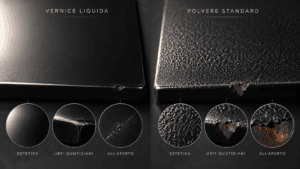
Faced with the risks of standard industrial coatings, at Decimus we decided not to compromise. We discarded the quick fix and opted for a more complex, expensive, and artisanal approach: 2K DTM (Direct To Metal) acrylic enamels applied to a manually prepared base.

It's not just paint, it's an integrated system. Here's what it means for your table and the disasters we avoid:

1. Chemical-Mechanical Adhesion (The end of the “Film” effect): While the powder “settles” mechanically, our 2K DTM enamels create a double bond: they anchor themselves to the roughness of the manual preparation AND react chemically with the metal.

  • What we solve: We permanently eliminate the risk of peeling paint. The paint isn't a separate shell, but becomes an integral part of the metal surface. It will never peel off in large pieces.

2. Structural Elasticity (No more chipping): The two-component acrylic enamel is formulated to remain elastic. Iron moves (with heat and cold) and the table is subject to vibrations. Our paint moves with the iron, not against it.

  • What we solve: Where cheap powder coatings (rigid and glassy) chip off at the first impact or crack due to expansion, our finish absorbs mechanical stress without breaking.

3. True Visual Depth (No Plastic Effect): Thick powder coatings often drown out details, giving a synthetic, rubbery feel. Our liquid application is thin, tight, and defined.

  • What we solve: We restore the nobility of metal. Light doesn't bounce off a layer of plastic, but interacts with a deep, textured surface. It's the difference between a mass-produced piece of furniture and a handcrafted design piece.

4. The Power of Retouching (The Immortality of the Piece): This is the ultimate advantage. If you accidentally scratch a liquid-painted Decimus leg in 10 years, the damage can be repaired locally with a simple touch-up kit, restoring its perfect condition.

  • What we solve: With powder coating, a deep scratch often destroys the entire leg (because it can't be repaired invisibly). With our system, your investment is protected forever: the table can be restored endlessly without needing to be replaced.

5. Total Edge Control: Manual preparation and spray painting allow us to insist on and visually check every single edge and weld.

  • What we solve: No "edge escape" or dead spots. The craftsman's eye sees where automation fails, ensuring critical points have the same protective thickness as flat surfaces.

Bottom line: Is it more work? Yes. Is it more expensive? Absolutely. But it's the only way to ensure that the structure supporting your precious piano is not only beautiful on day one, but remains impeccable for generations.

When you mount Decimus iron legs

You feel it right away:

in weight

in rigidity

in the total absence of movement

The welds are continuous, not hidden. The plates are 5 mm. The squares are controlled.

You climb, tighten, take a step back. And you realize you're not hoping it will hold, you know it will.

Conclusion

Decimus isn't the cheapest option. Nor is it the most hyped up by marketing.

It's the choice of those who:

he knows iron

he knows the numbers

He wants iron legs for tables that will still be there in ten years, still standing

We don't sell compromises. We sell structures.

Discover the quality of our iron legs.

FAQ

I have a very heavy countertop (marble/granite/glass). How do I know if the structure will actually hold up?

Unlike many retailers who give standard answers, we start with your tabletop. We don't just say "it holds 200kg," we calculate how the weight is distributed. If the span (the distance between the legs) is too large for your tabletop material, we'll let you know in advance and suggest a structure with a reinforced frame or a different geometry. We won't sell unless we're certain of its stability.

Why do your legs cost more than those I find on major marketplaces, but less than luxury brands?

Because we eliminate the superfluous and invest in the essentials. Low-cost products save on preparation (no sandblasting) and materials (thin gauges). Luxury brands add marketing and distribution to the price. Decimus invests in "structural luxury": you pay for certified steel, hand welding, and professional painting. The price accurately reflects the value of the metal and Italian labor, without unjustified markups.

What's the difference between your coating and industrial powder coating?

It's a technological and tactile difference. We don't use traditional industrial powder coating (which often hides defects under a layer of plastic). We use 2K Catalyzed DTM (Direct To Metal) Acrylic Enamels . The process is rigorous: each piece is manually sanded with a grinder to open the pores of the metal, then thoroughly degreased and finally painted. The result? Exceptional chemical-mechanical adhesion and a more natural and profound aesthetic result. Furthermore, unlike powder, this finish is touch-upable : if you chip a leg in 10 years, it can be restored, whereas powder would have to be redone from scratch.

Can I request custom sizes?

Absolutely. We believe in "guided freedom." You can adjust the height and width to fit your chairs or the available space. However, if a measurement requirement compromises stability (e.g., a leg that's too tall and narrow for a heavy tabletop), we'll recommend the necessary technical modifications to ensure it stands safely.

Are your products also suitable for outdoor use?

The standard treatment is designed for high-quality interiors. If your table will be placed under a porch or in a garden, you must specifically request it. In that case, we will apply a protective treatment specifically for outdoor use. Honesty comes before sales: iron must be treated differently depending on its intended use.

You may also be interested in:

For those looking for a sturdy yet lightweight metal structure

€139

€289

Industrial design and maximum stability for your table

€179

€349

They combine visual power and artisanal precision

€209

€299

Designed to ensure maximum stability and a decisive look

€179

€389

Exceptional stability even for large surfaces

€199

€389

It represents the pinnacle of stability and modernity.

€199

€429

Related Articles: